
Why the National Trust Says the White House Ballroom Cannot Proceed Without Congress
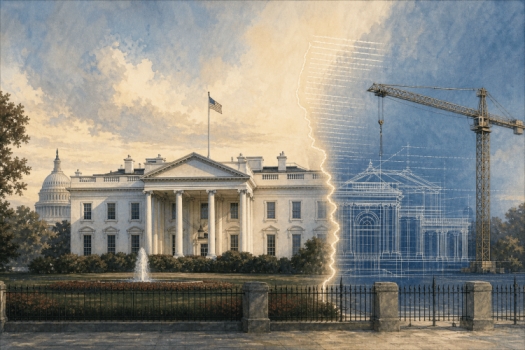
The National Trust for Historic Preservation is asking the Supreme Court to keep an injunction in place halting above-ground construction of a proposed $400 million White House ballroom. Its central argument is straightforward: the White House belongs to the American people, and the Constitution gives Congress—not the President—control over federal property.
According to the Trust, Article IV’s Property Clause gives Congress exclusive authority over federal property. Congress reinforced that authority in 40 U.S.C. § 8106, which prohibits construction of a building or structure on federal parkland in Washington, D.C., without Congress’s “express authority.” The Trust contends that no statute expressly authorizes the ballroom.
The government relies principally on two laws, but the Trust argues that neither is sufficient. First, the National Park Service Organic Act, 54 U.S.C. § 100101, does not expressly authorize construction in Washington. More importantly, the Trust says, the Act directs the Park Service to conserve historic objects and leave them unimpaired for future generations. The government’s own environmental review allegedly found that the ballroom would permanently disrupt the White House grounds’ historic continuity, sightlines, scale, and architectural balance. In the Trust’s view, a preservation statute cannot authorize the very impairment it prohibits.
Second, 3 U.S.C. § 105(d) does not give the President broad power to rebuild the White House. The Trust reads that provision as allowing Congress to appropriate funds for care, maintenance, repair, alteration, and improvement of the Executive Residence—and permitting the President to spend only those appropriated funds for their designated purposes. Congress has recently appropriated $2.475 million annually for maintenance and safety work, not hundreds of millions for a privately funded ballroom. Nor, the Trust argues, can the Economy Act transfer authority that neither the Park Service nor the Executive Residence possesses.
The Trust also defends its standing to sue. One longtime member, architectural historian Alison Hoagland, lives near President’s Park, visits about monthly, and regularly studies and enjoys its historic architecture. The ballroom’s alleged permanent effects on her use and enjoyment of the park are concrete aesthetic and professional injuries, the Trust says—not merely disagreement with government policy. Protecting the White House also falls squarely within the Trust’s congressionally established preservation mission.
Finally, the Trust argues that the balance of harms strongly favors maintaining the injunction. The government says the ballroom may soon become virtually impossible to remove or alter. Allowing construction to continue could therefore eliminate any meaningful judicial remedy and permanently injure the Trust, its members, and the public. By contrast, the injunction permits underground security work and other measures needed to protect the President, staff, grounds, and construction site. Any lawful ballroom project can proceed if Congress approves it.
The dispute, the Trust emphasizes, is not about whether a ballroom is good policy. It is about who has legal authority to decide. That allocation, it says, is fundamental to the Constitution’s separation of powers. Its answer is Congress, and until Congress acts, the injunction should remain.
Guy Vitetta, Charleston