

When Court Officials Cross the Line: The Murdaugh Jury Tampering Decision
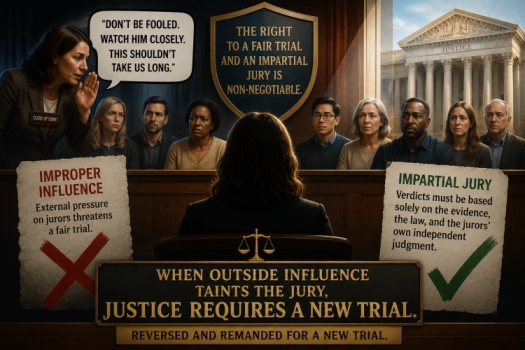
Today, May 13, 2026, in State v. Murdaugh, the South Carolina Supreme Court reversed Alex Murdaugh’s murder convictions and ordered a new trial after finding that Colleton County Clerk of Court Rebecca Hill improperly influenced the jury, violating Murdaugh’s constitutional right to a fair trial before an impartial jury.
The court held that Hill’s conduct constituted improper external influence on the jury under the longstanding legal principles established in Remmer v. United States. During trial, Hill repeatedly made comments to jurors about Murdaugh’s testimony and credibility, including warning jurors not to be “fooled” by the defense and encouraging them to closely watch Murdaugh’s body language when he testified. The Supreme Court found these comments were not harmless or incidental. Instead, they directly targeted the central issue in the case—Murdaugh’s credibility—and effectively urged jurors toward a guilty verdict.
The court emphasized that Hill’s status as Clerk of Court made the misconduct especially serious. As an elected court official responsible for managing the jury, her statements carried substantial authority and influence. The court also found credible evidence that Hill was motivated by personal ambition and publicity surrounding the trial, including her desire to profit from a book about the proceedings.
Importantly, the Supreme Court clarified South Carolina law regarding jury tampering and external influence. The court formally adopted the Fourth Circuit’s three-step Remmer analysis for cases involving improper outside contact with jurors. Under this framework, once a defendant shows that outside communications with jurors were “more than innocuous,” prejudice is presumed and the burden shifts heavily to the State to prove there was no reasonable possibility the verdict was affected.
The court concluded the State failed to overcome that presumption. Although the prosecution presented substantial evidence of guilt, the court ruled that the integrity of the jury process itself had been compromised. The opinion repeatedly stressed that constitutional guarantees of fairness and impartiality must prevail even in highly publicized and emotionally charged cases.
The decision serves as one of the strongest modern reaffirmations in South Carolina that no criminal conviction—regardless of the defendant or public opinion—can stand when court officials improperly interfere with the jury’s independent deliberations.