

Facts Matter: The South Carolina Supreme Court Extends Stand Your Ground Immunity to a Third Party B
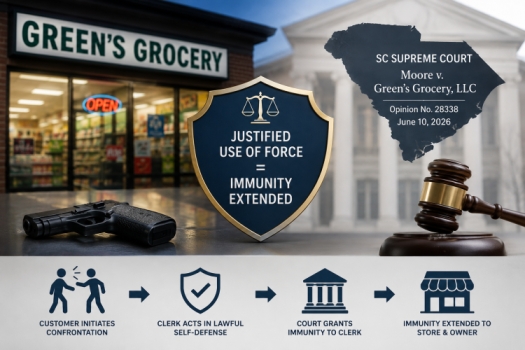
In Moore v. Green's Grocery, LLC (Opinion No. 28338, June 10, 2026), the South Carolina Supreme Court clarified an important principle in negligence law: when the negligence involves a claim that a homicide is legally justified under South Carolina's Protection of Persons and Property Act, the facts leading up to that shooting can determine not only the shooter's immunity, but also the immunity of third parties connected to the event.
The facts were critical.
A customer entered a Charleston convenience store and became involved in a heated verbal confrontation with store clerk Suhib Yousef, an employee. According to the evidence, the customer repeatedly refused demands to leave the store, threatened the clerk, knocked items from the counter, spit on him, and ultimately left the store before turning around and charging back toward the clerk while the clerk held a firearm. The clerk shot the customer, who later died from his injuries.
Prior to the civil lawsuit, a Judge Markley Dennis conducted an immunity hearing and found that the clerk was not at fault in bringing about the confrontation, was lawfully present in his place of business, and reasonably feared imminent serious bodily injury when the customer rushed him. As a result, the clerk received immunity from prosecution under South Carolina's Stand Your Ground law.
The decedent's estate then sued the grocery store and its owner, alleging negligent supervision and negligent entrustment because the owner had armed the clerk after an earlier robbery and allegedly knew the clerk was fearful and inexperienced with firearms.
The Supreme Court held that those claims failed because the shooting itself had already been determined by Judge Dennis to be lawful and justified. The Court reasoned that the plaintiff's negligence theories ultimately depended on proving wrongful conduct by the clerk. Once the shooting was deemed justified as a matter of law, there was no underlying wrongful act to support liability against the store or its owner. In the Court's words, the case "rises and falls with the justification for the shooting."
The lesson from Moore is straightforward: where the facts establish a lawful use of force under South Carolina's Protection of Persons and Property Act, immunity may extend beyond the individual actor and shield employers or business owners from related civil claims as well. The outcome was driven not by abstract legal theory, but by the Court's acceptance of the factual findings that the customer was the aggressor and the clerk's use of deadly force was justified.
Guy Vitetta, Charleston