
A Significant Ruling for Victims Seeking Protection From Harassment During Divorce
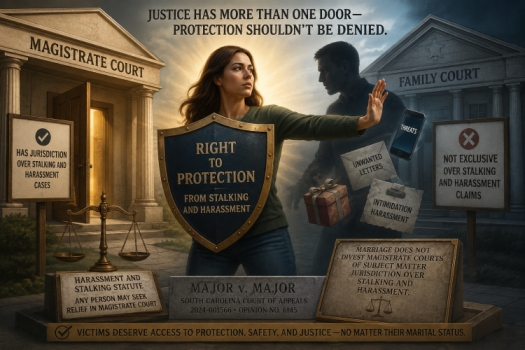
Today, May 13, 2026, in the case of Major v Major, the South Carolina Court of Appeals issued an important clarification regarding the jurisdiction of magistrate courts in stalking and harassment cases involving married parties. In Major v. Major, the court held that a magistrate court retains subject matter jurisdiction to hear requests for restraining orders under South Carolina’s Harassment and Stalking Statute even when the parties are spouses involved in an ongoing family court matter.
The case arose after Emily Major sought a restraining order against her husband during a pending divorce action. She alleged a disturbing pattern of conduct that included repeated unwanted gifts, emails, and letters, as well as threats of sexual assault and suicide. She also informed the court that her apartment complex had issued a trespass notice against her husband after he allegedly assaulted a neighbor. Despite these allegations, the magistrate court dismissed her request solely because the parties were married, concluding the matter belonged exclusively in family court.
The Court of Appeals reversed that decision. Focusing closely on the language of the applicable statutes, the court explained that the Harassment and Stalking Statute expressly permits “any person” to seek relief in magistrate court. The court further emphasized that the Protection from Domestic Abuse Act addresses “abuse” between household members, but does not eliminate magistrate court jurisdiction over independent claims of stalking or harassment.
Importantly, the court recognized that stalking and harassment are legally distinct from domestic abuse under South Carolina law. Although some conduct may overlap, the existence of a marital relationship does not deprive magistrate courts of authority to issue restraining orders addressing harassment and stalking allegations.
The holding is significant because it expands practical access to protection for victims who previously may have been turned away due to jurisdictional confusion. The decision ensures that married individuals seeking immediate relief from stalking or harassment are not left without a remedy simply because a family court action is pending.
Guy Vitetta, Charleston SC