
“My Spouse Can’t Testify Against Me”—Right?
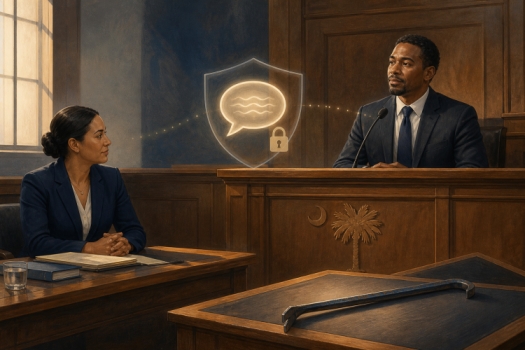
Imagine police accuse Alex of burglary. The night of the crime, Alex tells his spouse, Jamie, “I hid the stolen jewelry in our garage.” Jamie also sees Alex arrive home carrying a crowbar. When prosecutors subpoena Jamie, can Alex prevent the testimony?
Only partly.
South Carolina recognizes marital privilege under S.C. Code Ann. § 19-11-30 and Rule 501 of the South Carolina Rules of Evidence. But the privilege is not a blanket rule preventing one spouse from testifying against the other. Instead, it primarily protects communications made between spouses during their marriage.
In a criminal proceeding, a spouse generally cannot be compelled to disclose any communication made by one spouse to the other during the marriage. Thus, Jamie could invoke the privilege when asked what Alex said about the jewelry.
The crowbar is different. Jamie observed it personally; Alex did not communicate that fact. Because the privilege protects communications—not everything a spouse sees, hears from others, or discovers independently—Jamie may be required to testify about that observation.
Another important limitation concerns who controls the privilege. South Carolina’s Supreme Court has held that the right belongs to the spouse being asked to testify. State v. Motes, 264 S.C. 317, 215 S.E.2d 190 (1975); State v. Copeland, 321 S.C. 318, 468 S.E.2d 620 (1996). Jamie may claim the privilege, but Alex ordinarily cannot use it to prevent Jamie from testifying voluntarily.
Civil cases receive somewhat narrower protection: Section 19-11-30 covers confidential marital communications, rather than every communication. The statute also requires disclosure when a proceeding concerns child abuse or neglect, a child’s death, or criminal sexual conduct involving a minor.
The takeaway? Marriage does not create a courtroom force field. South Carolina protects qualifying communications between spouses, but it does not necessarily protect observations, independently obtained evidence, or voluntary testimony. Anyone facing a subpoena should obtain legal advice before answering—or refusing to answer—questions.
Guy Vitetta, Charleston